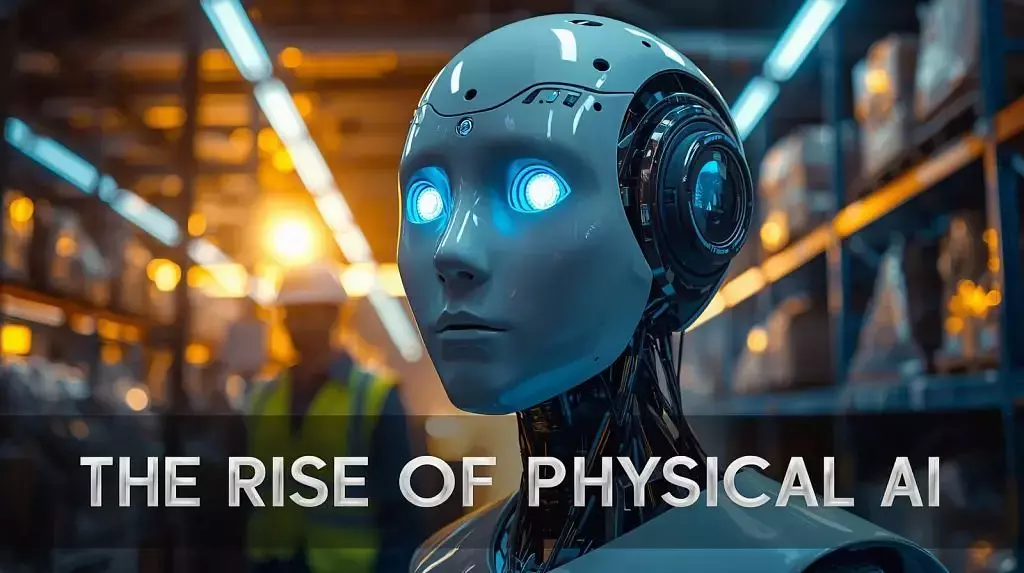
For years, artificial intelligence lived in our imagination, portrayed as humanoid machines capable of thinking and acting beyond human limits. It felt cinematic and distant, more at home in science fiction than in the workplace.
AI didn’t stay in the realm of science fiction for long. It entered everyday work through our screens, writing emails, summarising reports, generating code, and answering questions in seconds.
The next shift is happening in the physical world. Physical AI systems can perceive their surroundings through sensors and cameras, interpret signals using machine learning and large language models, take action, and improve through experience. In warehouses, robots move inventory alongside people. In hospitals and manufacturing plants, machines transport supplies and inspect equipment. Intelligent systems are already embedded in operational environments.
What Physical AI Means for Businesses
The rise of physical AI is driven by labour shortages and the need for resilient operations. Unlike traditional automation, which follows fixed rules, physical AI adapts. It navigates unpredictable spaces, responds to obstacles, and adjusts in real time.
For organisations, intelligence is no longer confined to dashboards or back-office tools. It now supports logistics, production inspection, hospital coordination, and facility monitoring, reducing risk and assisting employees with repetitive or hazardous tasks.
But as intelligence spreads into physical systems, complexity increases. Every robot, sensor, and connected device becomes part of the network. Each must be managed and secured.
Digital infrastructure and physical operations are converging, so a compromised credential or vulnerable device is no longer just a data issue. It can disrupt machinery, building systems, or access controls. And because physical AI relies on real-time processing, organisations need edge computing and resilient networks to keep decisions fast and operations stable.
Cybersecurity in a Physical AI World
As AI systems gain physical capabilities, cyber threats carry greater consequences.
Attackers may manipulate training data, introduce adversarial inputs, or exploit compromised identities to bypass controls. In AI-monitored environments, behavioural data such as routines and movement patterns can also become a vulnerability.
The growing link between IT and operational technology raises the stakes. If connected machinery or industrial controllers are compromised, operations can halt, and safety can be affected.
Cybersecurity in this context is about protecting infrastructure, continuity, and people, not just information.
Management and Governance
Physical AI reshapes management responsibilities. Organisations will rely more on predictive maintenance, using AI analytics to identify issues before they disrupt operations. IT teams will shift toward proactive oversight of intelligent systems.
New expertise will be required, including AI governance, robotics integration, and AI-specific security practices. Despite increasing autonomy, human oversight remains essential, particularly in safety-critical environments. Clear accountability structures are critical as regulatory expectations evolve.
Planning for an AI-Enabled Workplace
As physical AI matures, organisations need a clear strategy for integrating AI-powered devices into broader IT planning. AI-enabled PCs, smart sensors, and robotics are reshaping infrastructure roadmaps. Businesses should assess readiness for AI workloads at the endpoint and edge while updating cybersecurity frameworks to reflect AI-driven decision-making systems.
Pilot programs can help test use cases, measure impact, and identify risks before scaling.
Final Thoughts
Physical AI marks a shift in how intelligence is deployed across the enterprise. What once operated in software now functions within devices and facilities.
The benefits are clear: improved efficiency, enhanced monitoring, and greater resilience. But as intelligence moves into the physical world, the stakes rise. Security, infrastructure, governance, and skills must evolve alongside adoption.
AI is no longer confined to code or cloud platforms. It is becoming part of the environments where work happens, and organisations must be prepared.
Want to explore how AI can be implemented in your business safely and effectively? Connect with our experts from coast to coast today: https://microage.ca/contact-us/
Share